
HANDSFORUM 2023
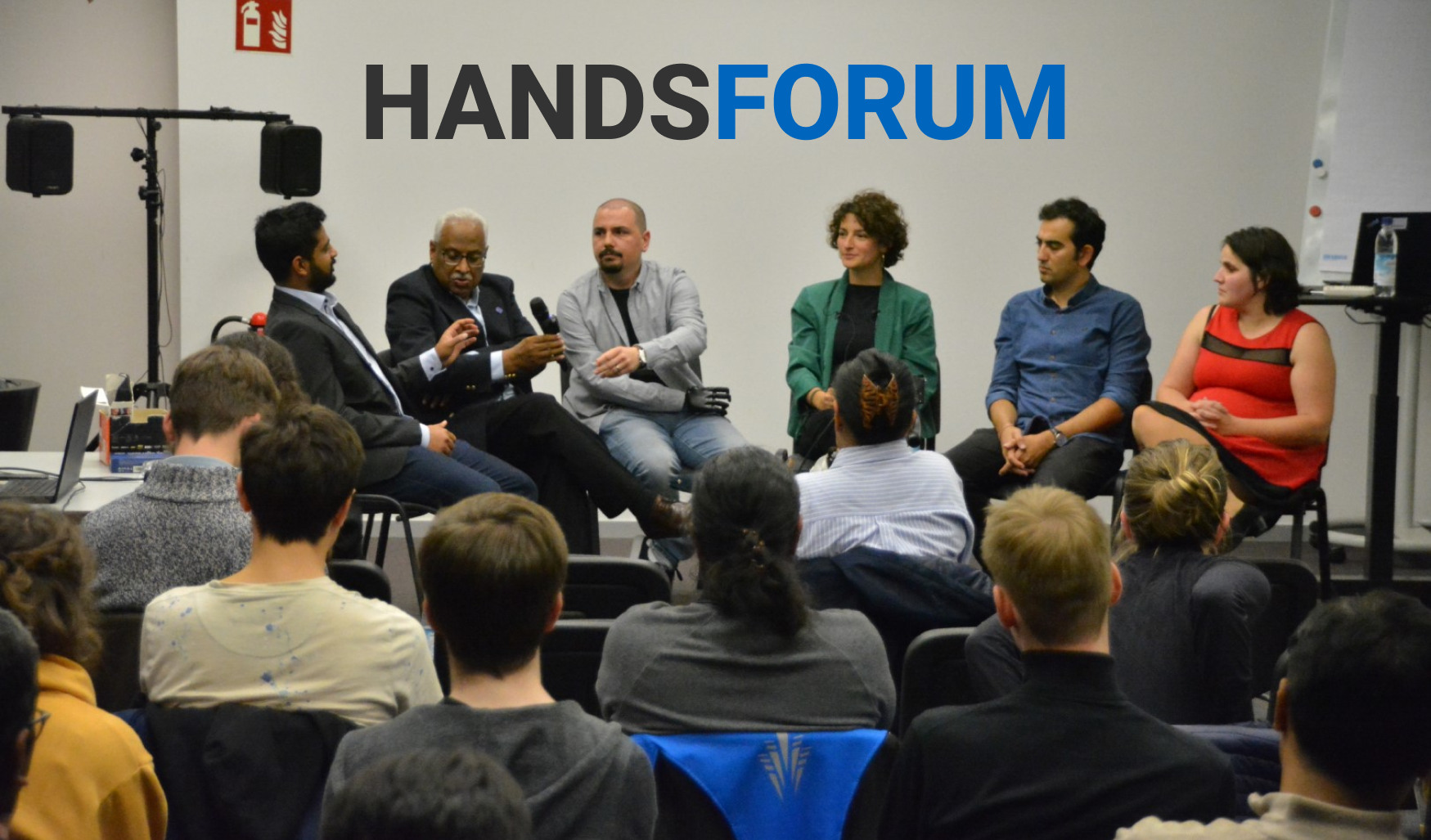
An evening filled with expert talks, the latest technology insights in robotics and prosthetics, an engaging panel discussion, and networking over drinks – that was this year's HANDSFORUM, hosted by EnHands. The event kicked off at the TU München MIRMI lab on Georg-Brauchle-Ring with a warm welcome to over 30 attendees and another 30 watching online. The topic for this year was to compare the contrast between the states of prosthetic development and patient care in low-income countries and the developed world.
The Keynote Speaker, Dr. Viquar Qurashi, an orthopedic surgeon and founder of the Naya Quadam charity, set the scene with his moving talk on amputation in the developing world. Dr. Qurashi shared his 30+ years of experience and painted an eye-opening picture of the circumstances in which each patient finds themselves after limb loss. "If you are a patient in a third-world country, you have three options: either you end up begging and lose your dignity, or you try to mask the injury and lie down all day, in which case you risk bed sores that promote infections and could lead to death." Patients have a third option and can build themselves a prosthesis with all the means available (e.g., a leg from a tree). In contrast to Europe, where patients are "spoiled for choice," the common problem in developing countries is the simple distribution of prosthetic aids.

Dr. Qurashi emphasized the importance of understanding the unique needs of patients in developing countries, which differ from those in the Western world. As a prosthetics manufacturer for low-income countries, it is crucial to consider factors such as how individuals pray, sit (cross-legged), and face the challenge of not having the option to change jobs after limb loss. Instead, they need to continue in the same job if they want to survive.
A sharp contrast to Dr. Qurashi's talk was presented by Prof. Natalie Vanicek, a Professor of Clinical Biomechanics at the University of Hull, based on her research on lower limb prosthetics in England. Disparities also exist in the UK between the more deprived North and the wealthier South. This disparity contributes to a lower health status for people living in the northern part, more often resulting in the loss of a limb due to illnesses such as diabetes or high blood pressure.
Professor Vanicek highlighted the fact that, while patients in developing countries often struggle to survive, patients in the developed world do not face such challenges and are mostly interested in the functionality of a prosthesis. Dissatisfaction with provided prostheses is common, as some patients in the developed world perceive them as ugly, heavy, and immobile.

Next Speaker, Dr. Sabine Thürauf from the Assistive Intelligent Robotics Lab, FAU Erlangen-Nürnberg, shed light on Low-Cost Wearable Sensor Solutions. Dr. Thürauf presented sensors equipped to measure muscle contraction, force, and load. She brought insights on recent development in tracking devices that are designed to monitor the movement of arms. In the context of developing countries, there is a unique opportunity to develop devices with a single degree of freedom, specifically designed for grasping objects. This cost-effective solution has the potential to make a significant difference by providing essential functionality at a more affordable price.

Dr. Utku Culha, Chair of Safety, Performance, and Reliability for Learning Systems at TUM, provided a unique robotics perspective on prostheses. His presentation on design principles for soft-rigid hybrid robotic grippers encouraged 'out-of-the-box' thinking in developing prosthetics for human use. Dr. Culha explained how the latest robotics research could contribute to developing a soft hand joint in prosthetics, enabling patients to bend fingers, pick up things, and bend at the wrist. The key takeaway from Dr. Culha's talk was embracing the concept of affordable robotics, revolving around leveraging common materials and assembling them to create robotic functionalities, making robotics more accessible and cost-effective.

Dr. Anand Suresh from the Laboratory of Product Development and Lightweight Design, TUM, concluded the expert talks with his presentation on "Bridging the Gap: Towards Realizing Advanced Robotic Hand Prosthetics." Once again, he compared the gap between the two worlds. In developing countries, only the privileged can afford prostheses, while in the Western world, prostheses are marketed as a lifestyle. Dr. Suresh raised a question of how researchers can bridge the gap—“how are we going to bring the recent developments in robotics engineering to the third world?” The answer lies, according to Dr. Suresh, in user-centric design and low-cost modeling, manufacturing, and training. He encouraged experimenting, being curious, and trying new approaches.

The evening continued with a round table discussion, featuring Adnan Jukic as a special guest, who shared his experience growing up with hand prostheses from a very young age. Experts discussed topics from the engineering point of view: how to design a prosthesis for low-income countries and what it means to live with a prosthesis. One common agreement was that the prosthesis needs to be comfortable for the patient, cannot cause swelling, and should seamlessly blend with the body without causing any discomfort. If the technologically most advanced prosthesis is not comfortable to wear, the patient will not wear it. Therefore, when developing a prosthesis, manufacturers should always keep patient needs in mind and strive to address them in the best way possible.
In case you missed the event, you can watch our recording on YouTube:
We're also happy to make available the slides of Viquar Qurashi's talk, Natalie Vanicek's talk, Utku Culha's talk, and Anand Suresh's talk.
Impressions from the HANDSFORUM


